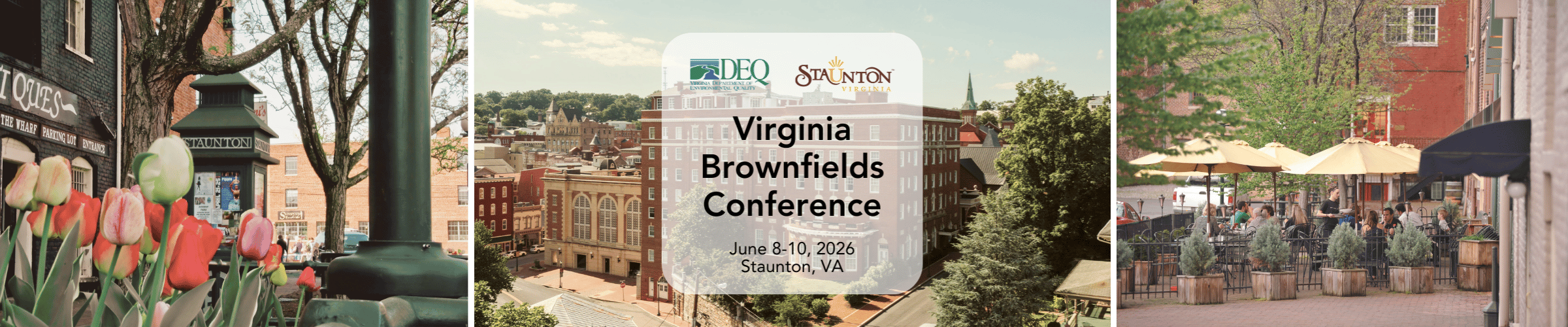
The premier brownfield redevelopment conference in Virginia is hosted by the Virginia Department of Environmental Quality (DEQ) and the City of Staunton.
Sign up or log in to add sessions to your schedule and sync them to your phone or calendar.
Brownfields "Educational" Session - Reuse of Old School Buildings. This session shares case studies showing how communities turned vacant or underused school buildings into vibrant assets by leveraging EPA Brownfields resources. We’ll walk through how Assessment and Cleanup funds addressed legacy hazards (e.g., asbestos/lead, tanks, moisture and vapor issues), how Alternatives Analyses and community engagement shaped feasible reuse concepts, and how cleanup was sequenced to protect the community and speed construction. You’ll see what Brownfields dollars can and can’t pay for, how to document site eligibility and ownership, and how to stack additional financing (e.g., tax credits, grants, state funds) once environmental risks are managed.
The Mary E. Branch School has a layered history tied closely to African American education, segregation, and civil rights in Farmville, Virginia. The building began as the Farmville Colored School in 1926 and was ultimately renamed the Mary E. Branch School in 1939 to honor a pioneering Black educator. The story behind the schools history plays a central role in the desire to reuse the building as a community space. Brownfields fundings has been utilized to address asbestos containing materials, impacts from potential former boiler systems, and reuse planning.
This session will discuss both preventative and remedial strategies that local governments can use to address vacant, dilapidated, or contaminated commercial, industrial, and brownfield properties. A series of educational materials is being developed through a partnership between VDEQ, the U.S. Environmental Protection Agency ( Mid-Atlantic Technical Assistance to Brownfields (EPA-TAB) program, the Brownfields Assistance Center, and the Land Use Law Clinic at West Virginia University. Topics for technical assistance will include, but are not limited to, vacant property registration programs, nuisance ordinances, site control, and zoning. The session will highlight success stories and lessons learned during the development of these materials.